
IGI CableTM is the oldest manufacturerof Nyvin / Uninyvin Cables in the world. Nyvin cables are known for their higher current carrying capacity which makes them economical when compared to PVC cables. They have a much superior chemical resistance than PVC Cables and a temperature range from -30°C to 105°C.
A 120 mm2 PVC Cable and a U-0 (53 mm2) have the same current carrying capacity. For a given size, Nyvin cable has up to 2x the current carrying capacity than that of PVC Cable. The huge saving on copper makes Nyvin Cable much more economical than PVC Cable.
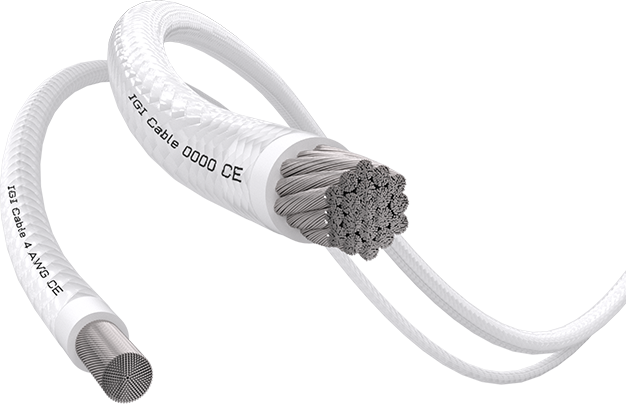
Flexible tinned copper wires + HR-PVC insulation + Coated Synthetic Yarn Braid
Multiple variations of this construction can be made, please see the Technical Data Sheet or Contact Us for more information.
Flexible tinned copper wires + HR-PVC insulation + Fibre Glass Yarn Braid + Coated Synthetic Yarn Braid
Multiple variations of this construction can be made, please see the Technical Data Sheet or Contact Us for more information.
Flexible tinned copper wires + HR-PVC insulation + Fibre Glass Yarn Braid + Coated Synthetic Yarn Braid + HRFR Outer Sheath
Multiple variations of this construction can be made, please see the Technical Data Sheet or Contact Us for more information.

© 2019. IGI Cables. All Rights Reserved. Certifications | Download Center | Privacy | Legal & Copyright Managed by Effervescent


